

In 2025, KHAAN Bangkok began a new journey beyond the walls of our dining room. Led by Chef Aom Sujira Pongmorn, KHAAN on Tour was created with a simple but meaningful mission: to keep Thailand’s food cultures alive by learning directly from local communities, preserving their wisdom, and sharing their stories through contemporary Thai cuisine.
For us at KHAAN Bangkok, food has always been more than flavor and technique. It is memory, identity, and connection. It carries the voices of grandmothers, farmers, foragers, and village elders. Our first destination on this journey was Chiang Rai, the northernmost province of Thailand — a land of misty mountains, diverse ethnic cultures, and ingredients rarely seen in Bangkok.
Why Chiang Rai?
Chiang Rai is more than a scenic province. Bordering Myanmar and Laos, it is a cultural crossroads where traditions blend across generations and nationalities. Hidden in its highlands are villages that still maintain ancient ways of cooking and living — some without full access to electricity, relying instead on candlelight and solar panels.
For Chef Aom and the KHAAN team, this was the perfect place to begin.

We traveled deep into the mountains to visit an Akha village — a community of the Akha people, one of the hill tribes of Northern Thailand whose culinary traditions are deeply connected to the land. The Akha cuisine reflects resilience and resourcefulness: wild herbs, forest vegetables, fermented elements, and simple but powerful seasoning techniques.
From the moment we arrived, we felt we were stepping into a living archive of food heritage.

Learning from the Akha Community
The head of the village warmly welcomed us and guided us through the hills surrounding their homes. There, we were introduced to ingredients that rarely appear in urban markets.

One of the most special discoveries was a local sumac from the Akha hills — a bright, tangy spice that the villagers consider a symbol of luck and happiness. According to tradition, adding this sumac to dishes brings joy and harmony to the family. It is not just seasoning; it is belief, culture, and emotional connection woven into food.
We foraged together, tasting leaves, smelling roots, and listening carefully as the elders explained how each ingredient is used — which leaves are eaten fresh, which must be grilled, which are medicinal, and which are reserved for celebrations.

Perhaps the most touching moment was meeting the village grandmother, who still cooks daily for her family. Her hands moved with quiet confidence over charcoal fire. She smiled brightly when she learned that we had traveled from Bangkok simply to learn from her. In that humble kitchen, illuminated only by candlelight and natural daylight, we were reminded that true culinary mastery does not require modern equipment — it requires knowledge passed down with care.
Cooking Together Without Electricity
Life in the village is simple. Without full electricity infrastructure, many families rely on solar panels and candles. Cooking is done over wood fire, where smoke adds another layer of flavor and memory.

Chef Aom and the team joined the villagers in preparing a meal together. We shared techniques — fermentation methods, preservation ideas, plating concepts — while they shared their ancestral wisdom.
This exchange was not about teaching. It was about mutual respect. The Akha community showed us how deeply connected their cuisine is to nature and seasonality. Nothing is wasted. Every plant has purpose. Every harvest is appreciated.
For KHAAN, whose philosophy centers on sustainability and honoring Thai ingredients, this experience reaffirmed why we continue to travel, learn, and adapt.
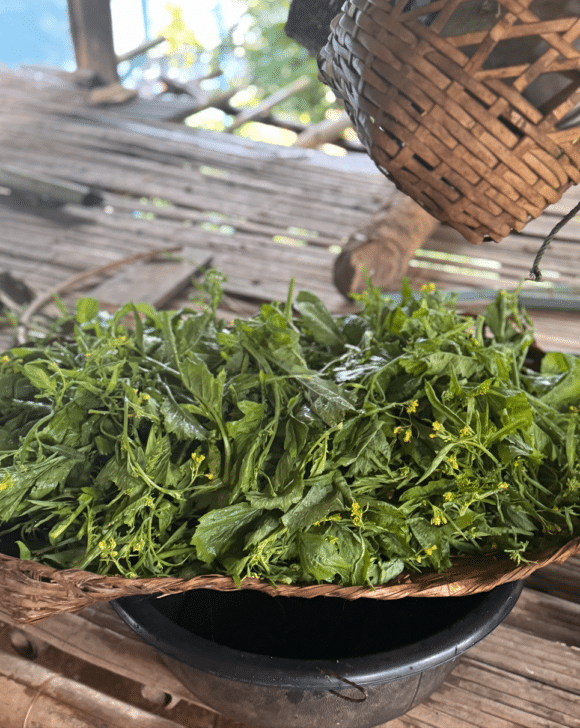
Several vegetables we encountered are rarely available in Bangkok — wild greens with complex bitterness, mountain herbs with citrus aroma, and roots that deliver earthy sweetness. These ingredients will inspire future tasting menus at KHAAN Bangkok, carefully adapted while preserving their original spirit.
The Magic of Mae Sai Market
Our journey in Chiang Rai continued at one of the most fascinating markets in Thailand: Mae Sai.
Located at the border between Thailand and Myanmar, Mae Sai wakes before dawn. At around 4:00 AM, vendors from across the border arrive to sell fresh produce, herbs, spices, and specialty products. By 6:00 AM, many have already packed up and crossed back.

To truly experience Mae Sai Market, you must rise early.
In the quiet darkness of early morning, the market buzzes with activity. Burmese traders bring forest mushrooms, fermented tea leaves, rare dried spices, mountain garlic, and seasonal vegetables that disappear quickly once the sun rises. Some ingredients appear only for a few weeks each year.
For chefs, this market is a treasure trove.
Chef Aom explored each stall carefully, asking questions, tasting samples, and learning about sourcing routes. Many ingredients found here never make it to large distribution systems. They exist only within local trade networks — a reminder that some of Thailand’s richest flavors are still hidden in plain sight.
Bringing Chiang Rai to Bangkok
KHAAN on Tour is not about replication; it is about inspiration and preservation.
The ingredients and stories gathered from Chiang Rai will influence upcoming tasting menus at KHAAN Bangkok. However, our approach remains thoughtful and respectful. We will honor the Akha community by highlighting their ingredients while acknowledging their origin.

Our goal is not to modernize their cuisine, but to celebrate it — to introduce diners in Bangkok to flavors that exist beyond the city’s borders.
By doing so, we hope to create awareness and appreciation for the communities that protect these traditions.
More Than a Culinary Trip
This journey to Chiang Rai was a reminder that Thai cuisine is not singular — it is diverse, layered, and deeply regional. Each province holds its own culinary identity shaped by geography, climate, and cross-border influence.

For Chef Aom, traveling north reinforced the belief that true luxury in fine dining comes from authenticity and sustainability. Supporting local farmers and hill tribe communities ensures that their traditions continue for future generations.
At KHAAN Bangkok, we believe fine dining should not separate itself from rural roots. Instead, it should elevate and protect them.
Looking Ahead: The Future of KHAAN on Tour
Chiang Rai is only the beginning.
KHAAN on Tour will continue across Thailand — exploring coastal fishing villages, southern curry communities, Isaan fermentation masters, and central Thai heritage kitchens. Each journey will deepen our understanding of Thailand’s culinary identity.

Through storytelling, collaboration, and ingredient exploration, we aim to build a bridge between remote communities and urban diners.
Because when we preserve food culture, we preserve history.
And when we cook with understanding, we cook with purpose.
Experience the next chapter of KHAAN Bangkok’s tasting menu, inspired by our journey to Chiang Rai — where mountain herbs, Akha sumac, and border market discoveries meet contemporary Thai fine dining.
Stay tuned as KHAAN on Tour continues to celebrate the flavors of Thailand — one village at a time.